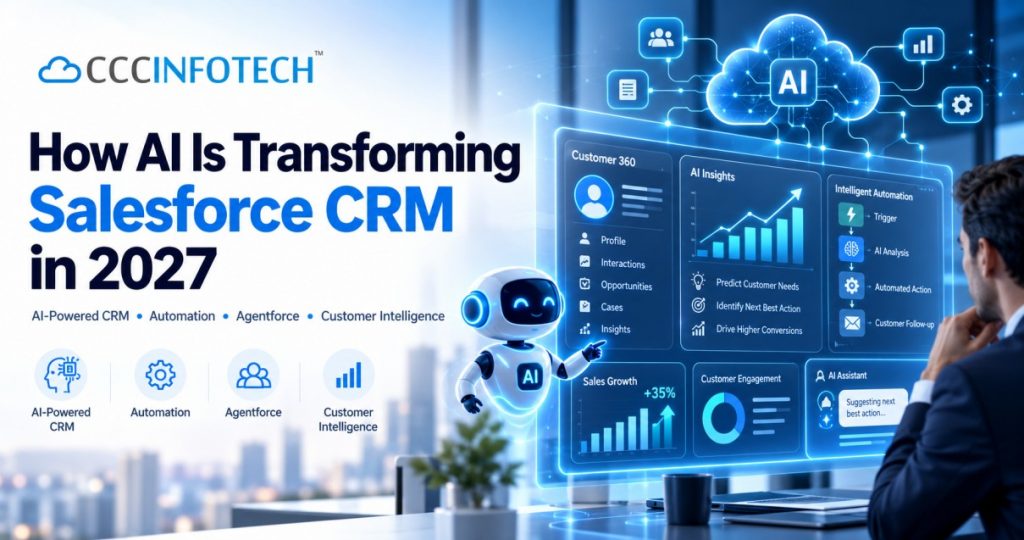
How AI Is Transforming Salesforce CRM in 2027
Discover how AI is transforming Salesforce CRM in 2027 through Agentforce, intelligent automation, AI-powered sales, customer service, analytics, and connected customer data.

Discover how AI is transforming Salesforce CRM in 2027 through Agentforce, intelligent automation, AI-powered sales, customer service, analytics, and connected customer data.
Customer relationship management is entering a new phase.
For years, businesses have used Salesforce to manage leads, opportunities, customer interactions, service requests, marketing activities, and business data. Today, artificial intelligence is changing how those processes work.
Instead of simply storing customer information, modern Salesforce AI CRM capabilities are helping businesses understand data, automate repetitive activities, support employees with recommendations, and enable AI agents to take action across business workflows.
As organizations move toward 2027, the combination of AI and Salesforce CRM is likely to become increasingly important for companies looking to improve productivity, customer experience, sales efficiency, and decision-making.
Salesforce’s recent investments in Agentforce, enterprise data, automation, and AI agents already demonstrate this shift toward what the company describes as an agentic enterprise.
So, how exactly is AI transforming Salesforce CRM, and what should businesses prepare for?
Let’s explore.
AI in Salesforce CRM refers to the use of artificial intelligence, machine learning, generative AI, predictive analytics, and AI agents within the Salesforce ecosystem to help businesses work more intelligently with their customer data.
Traditional CRM systems primarily depended on employees to:
An AI-powered CRM can assist with many of these activities by analysing business data, identifying patterns, generating useful information, and automating selected processes.
This changes CRM from being primarily a system of record into a platform that can increasingly support employees in deciding what to do next.
Traditional Salesforce automation is based largely on predefined workflows, rules, triggers, approvals, and process automation.
For example:
If a lead reaches a certain score → assign it to a salesperson.
Or:
If an opportunity reaches a particular stage → create a follow-up task.
These workflows remain extremely useful.
However, AI agents introduce another layer.
With Salesforce Agentforce, businesses can create AI agents designed to understand business context, reason about tasks, access authorized data, and perform defined actions.
Rather than following only a rigid sequence of steps, AI agents can potentially manage more complex workflows involving multiple systems and decisions.
Salesforce has continued expanding Agentforce across sales, service, commerce, and other business functions.
Example
Imagine a customer contacting a company regarding an existing service request.
An AI agent could potentially:
The objective is not simply to automate clicks.
It is to create intelligent Salesforce automation that can work with context.
Sales representatives often spend significant time managing CRM activities instead of directly engaging with customers.
Typical tasks include:
Salesforce AI solutions can help reduce some of this administrative effort.
AI-powered capabilities can assist sales teams by generating summaries, analysing account information, suggesting actions, and helping employees work with CRM data using natural language.
This can allow sales representatives to spend more time on activities where human relationships remain essential, including:
In this way, AI in Salesforce Sales Cloud can become a productivity layer rather than simply another software feature.
Not every lead has the same likelihood of becoming a customer.
Traditionally, sales teams often relied on basic qualification rules or manual judgement to determine which leads deserved immediate attention.
AI can help make Salesforce lead management more data-driven.
An AI-enabled CRM can analyse factors such as:
Using this information, businesses can prioritize prospects and help sales representatives focus their attention more effectively.
From Lead Collection to Intelligent Prioritization
Instead of:
Lead submitted → salesperson manually reviews it
the process can increasingly become:
Lead submitted → data analysed → lead prioritized → relevant context provided → salesperson takes action
This makes AI-powered Salesforce CRM particularly useful for businesses managing large lead volumes.
Accurate forecasting has always been one of the most important—and challenging—parts of sales management.
Sales managers typically evaluate:
AI can add another level of analysis.
By identifying patterns across historical and current CRM information, Salesforce AI CRM capabilities can help organizations better understand pipeline health and potential risks.
For example, AI may help surface:
AI does not eliminate the need for sales judgement.
Instead, it gives decision-makers additional information that may help them make better-informed decisions.
Customer expectations have changed significantly.
Customers increasingly expect businesses to understand their previous interactions rather than forcing them to explain the same situation repeatedly.
This is where the combination of Salesforce Service Cloud and AI can be valuable.
AI-powered customer service can help organizations work with information such as:
AI can then assist service teams in identifying relevant information and generating potential responses.
For routine requests, AI agents may also be able to resolve certain issues automatically within defined business rules.
For complex or sensitive cases, human agents remain essential.
The result can be a hybrid customer service model where AI handles repetitive work while employees focus on situations requiring judgement, empathy, or expertise.
Artificial intelligence is only as useful as the information available to it.
If an organization’s customer data is incomplete, duplicated, outdated, or spread across disconnected applications, even sophisticated AI systems can struggle to provide relevant results.
This makes enterprise data management critical.
Salesforce’s Data 360, previously known as Data Cloud, is designed to bring information from multiple customer touchpoints together and provide trusted business context for employees and AI agents.
A customer could interact with a business through:
Connecting these interactions can provide a more complete customer view.
For organizations considering Salesforce AI implementation, improving data quality and integration should therefore be an important early step.
Traditionally, employees interact with CRM applications through dashboards, records, lists, filters, and reports.
Generative AI is introducing another approach:
natural-language interaction.
Instead of manually searching across multiple CRM records, an employee may increasingly be able to ask questions such as:
Which opportunities require attention this week?
Summarize my recent interactions with this customer.
What happened with this account during the last three months?
What open service cases does this customer have?
Prepare a summary before my customer meeting.
This type of conversational CRM experience can reduce the amount of time employees spend navigating software.
Salesforce’s recent integrations with external AI environments also point toward a future where users can interact with Salesforce information from more places instead of always working inside a traditional CRM interface.
Salesforce rarely operates alone.
Businesses commonly connect Salesforce with:
This makes Salesforce integration services increasingly important in an AI-driven environment.
An AI agent might need information from Salesforce but also require data or actions from another enterprise application.
For example:
A salesperson asks an AI assistant about an important customer.
The system might need to:
The value of AI therefore increases when business applications and data are properly connected.
Businesses exploring broader enterprise AI, custom AI applications, or integrations beyond CRM can also evaluate how AI solutions and enterprise application development can connect intelligence across their technology ecosystem.
CRM personalization has traditionally relied heavily on customer segments.
For example:
Industry = Real Estate → Send Campaign A
AI allows businesses to analyse considerably more customer context.
Depending on available data and appropriate permissions, companies can consider factors such as:
This can support more relevant interactions across sales, marketing, commerce, and customer service.
Instead of treating every customer within a segment identically, businesses can work toward more contextual customer experiences.
Salesforce contains enormous amounts of business information.
But storing data and understanding it are two different things.
Managers often need to examine dashboards, reports, spreadsheets, and multiple CRM views before reaching conclusions.
AI can help simplify this process by identifying patterns and summarizing information.
For example, managers might use AI-supported analytics to understand:
This moves CRM closer to an intelligent decision-support platform.
Salesforce AI Does Not Mean Removing Humans
One common misconception around AI-powered CRM is that AI will replace sales representatives, service professionals, marketers, and CRM administrators.
A more practical model is human-AI collaboration.
AI is particularly useful for:
People remain important for:
The most successful Salesforce AI implementation strategies are therefore likely to focus on augmenting employees rather than simply attempting to automate every process.
Adding AI to Salesforce does not automatically create business value.
Organizations need a strong implementation strategy.
AI requires reliable business information.
Organizations should identify duplicate, incomplete, inconsistent, and outdated CRM data before expanding AI usage.
AI systems must respect user permissions and organizational security policies.
Employees and AI agents should only access information they are authorized to use.
Disconnected systems limit the amount of useful context available to AI.
Proper Salesforce integration can therefore be critical.
Organizations need clear rules covering:
Companies should not implement AI simply because it is popular.
Start with measurable business problems.
For example:
Problem: Sales teams spend too much time preparing account summaries.
AI use case: Automatically generate an account summary using approved CRM information before meetings.
Clear use cases make it easier to evaluate business impact.
Businesses planning to expand their use of Salesforce AI solutions should consider the following steps.
1. Review Your Existing Salesforce Environment
Understand how Salesforce is currently being used across sales, service, marketing, and other departments.
2. Improve CRM Data Quality
Remove duplicates and establish consistent data management practices.
3. Identify High-Value AI Use Cases
Focus first on processes where AI can reduce repetitive work or improve decision-making.
4. Evaluate Integrations
Determine whether important customer information exists outside Salesforce.
5. Establish AI Governance
Define permissions, approval processes, security requirements, and human oversight.
6. Start With Focused Projects
Instead of implementing AI everywhere at once, begin with specific use cases and measure the results.
7. Work With an Experienced Salesforce Consulting Partner
AI implementations can involve CRM configuration, business process design, integrations, data architecture, automation, security, and governance.
An experienced Salesforce consulting partner can help businesses evaluate which Salesforce AI capabilities fit their requirements and create an implementation roadmap.
Salesforce CRM is evolving beyond traditional customer database management.
The direction of the platform increasingly combines:
CRM + Customer Data + Automation + Analytics + Generative AI + AI Agents
Salesforce’s recent development of Agentforce, Data 360, multi-agent orchestration, and AI integrations demonstrates how quickly this model is progressing.
Going into 2027, businesses are likely to focus less on asking:
“Can we use AI in Salesforce?”
and more on:
“Which parts of our Salesforce processes should AI improve?”
That is an important difference.
Successful AI adoption will not depend solely on deploying more technology. It will depend on connecting the right data, processes, people, integrations, and AI capabilities around genuine business requirements.
As businesses adopt intelligent CRM technologies, having the right Salesforce architecture and implementation strategy becomes increasingly important.
CloudCentric Infotech helps organizations plan, implement, customize, integrate, and optimize Salesforce solutions according to their business requirements.
Whether you are exploring Salesforce implementation services, Salesforce integration, CRM automation, Salesforce Agentforce, or AI-powered Salesforce solutions, a structured approach can help turn technology into measurable business outcomes.